Cancer research brings together information from pathology images, genomic data, clinical records and published studies. Each source offers a different view of the disease, but connecting these insights can take considerable time.
Agentic AI refers to AI systems that can work towards a defined goal by planning and carrying out a series of connected tasks. They can use tools, assess intermediate results and adjust subsequent steps based on what they find.
Unlike a conventional AI tool designed for one specific task, an agentic system can coordinate several activities within a broader workflow. For example, it could retrieve relevant research papers, organise findings, analyse a suitable dataset and prepare results for a researcher to review.
Agentic AI in cancer research introduces a way to coordinate multiple research tasks towards a shared goal. An AI agent can plan a sequence of steps, use relevant tools, examine the results and determine what to do next. This approach intends to help researchers explore complex questions more efficiently, while keeping scientific interpretation and decision-making in expert hands.
How Agentic AI Could Support Cancer Research
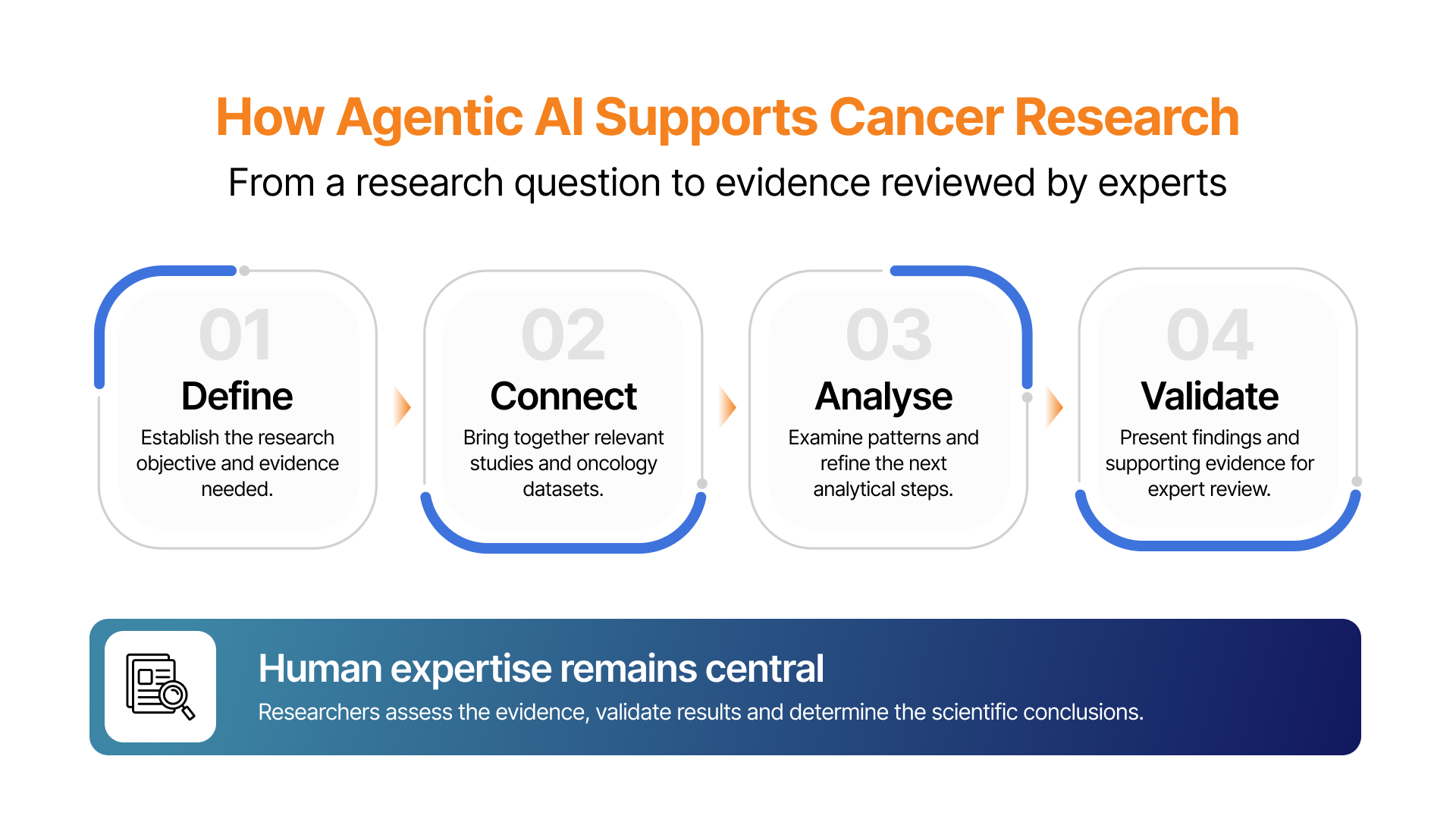
AI in cancer research can support different stages of investigation:
- Exploring tumour biology: Analyse pathology images to identify tissue patterns that may warrant further investigation.
- Connecting scientific evidence: Compare published studies, highlight areas of agreement and identify findings that need closer examination.
- Supporting research planning: Organise relevant evidence and assess study feasibility using defined criteria and available data.
A 2026 study in Nature Medicine offers a practical example. Researchers developed SPARK, an agent-based system that generates biological hypotheses and turns them into analytical methods for studying cancer pathology images. It was evaluated across 18 patient cohorts, covering five cancer types and more than 5,400 patients. The researchers reported promising findings related to tumour characteristics and patient outcomes, while noting that further prospective validation is needed to establish clinical utility.¹
Building Confidence Through Human Expertise
Agentic AI can coordinate complex tasks. However teams also need to understand how findings were produced, which evidence informed them and whether the results stand up to scientific scrutiny.
3 practices can help make these workflows more transparent and reliable:
- Traceability: Keep a clear record of the data, sources and steps behind each finding.
- Validation: Test whether results are reproducible and remain meaningful in appropriate independent datasets.
- Human oversight: Involve subject matter experts in interpreting results, assessing limitations and determining the next steps.
These practices provide a foundation for responsible AI in oncology research, helping teams combine the efficiency of connected AI workflows with the judgement and experience needed for sound scientific conclusions. Legal and ethical discussions around AI in oncology also reinforce the importance of clear accountability when AI contributes to research or clinical decisions.²
The Mango Sciences Lens
Mango Sciences uses AI in its Querent AI™ platform to support clinical research and make better use of patient data. Its work includes using Large Language Models (LLMs) and Generative AI to identify suitable patients for clinical trials, analyse real-world patient data and support research activities.
These applications highlight how AI can help research teams work with large amounts of clinical information, find relevant evidence and make research processes more efficient. This is particularly important in oncology, where understanding a patient’s treatment history, disease characteristics and clinical outcomes can help researchers answer important questions.
Connecting AI, Data and Oncology Research
Agentic AI offers a developing approach to coordinating research tasks, connecting evidence and exploring complex questions in cancer biology.
At Mango Sciences, the focus is on helping teams make better use of oncology data and evidence to support meaningful research. Explore Mango Sciences’ capabilities in oncology data and research solutions at mangosciences.com.
Sources
- Trost, F. et al. (2026). “An agentic framework for autonomous scientific discovery in cancer pathology.” Nature Medicine, 32, 2254–2266. Read the study
- Persad, G. (2026). “Understanding the Legal and Ethical Challenges AI Poses in Oncology.” ASCO AI in Oncology, 22 January 2026. Read the commentary